How to Rank on ChatGPT: Real-Time Search vs. AI Knowledge & How to Optimize for AISO (AI Search Optimization)

The New Search Landscape
For years, businesses have focused on ranking in Google search results. But today, tools like ChatGPT, Perplexity, Claude, and Gemini are changing how people find answers. Instead of scrolling through a page of blue links, users get direct answers — curated from either training data (knowledge embedded in the model) or real-time browsing.
If you’re wondering how to rank on ChatGPT or improve your AI SEO (AISO) strategy, the first step is understanding where these answers come from.
Real-Time vs. Knowledge-Based AI Responses
One of the biggest questions businesses are asking today is: “How do I get my company to show up in ChatGPT (or any AI assistant) when someone searches for what I do?”
The answer depends on where the AI is pulling its information from. And that depends on whether the question is broad/industry-level or specific/localized.
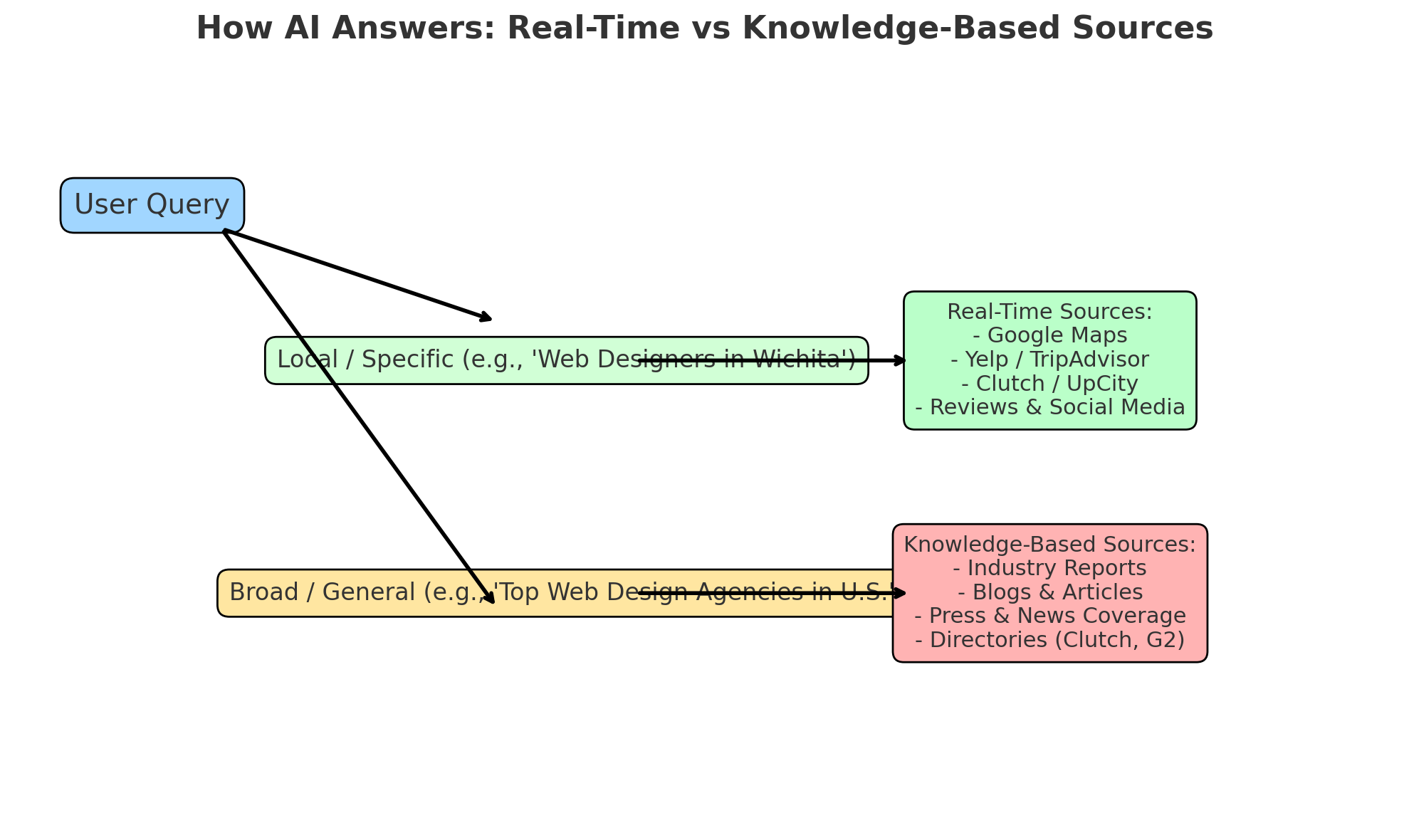
This image was generated by ChatGPT after it wrote this article.
Knowledge-Based (Pre-Trained) Sources
This is everything the AI has absorbed up to its most recent training cutoff. Think of it like a giant library of frozen knowledge.
What’s in here?
- Books, articles, and blogs available online.
- Industry rankings and reports (e.g., Clutch, G2, Gartner).
- News coverage from major outlets.
- “Best of” lists and evergreen blog posts (e.g., “Top 10 web design agencies in the U.S.”).
- Academic or research papers.
Strengths:
- Great for broad questions (“What are the leading web design trends of 2025?”).
- Provides answers on well-documented companies or industries (large agencies, global brands).
- Works without an internet connection or live lookup.
Limitations:
- Doesn’t capture brand-new businesses.
- Can’t update itself instantly when reviews change.
- May exclude hyper-local players unless they’ve been covered in an authoritative way.
Get your own FREE form with unlimited submissions with Deformity. Upgrade only if you want a custom domain and unlimited file uploads.
Real-Time (Live-Browsing) Sources
This is when the AI leaves its “frozen library” and actively pulls in fresh information from the web.
What’s in here?
- Google Business Profiles (the #1 source for local services)
- Yelp, TripAdvisor, and niche directories
- Social media (LinkedIn, Instagram, TikTok for businesses that post regularly)
- Review platforms (Clutch, DesignRush, ZocDoc, Healthgrades)
- E-commerce sites (Amazon reviews, Etsy ratings).
Strengths:
- Perfect for hyper-local queries (“web designers in Wichita, KS”)
- Always up to date with reviews, hours, and new businesses
- Surfaces companies that aren’t globally known but are locally dominant.
Limitations:
- Browsing takes extra processing time, so not all AI platforms do it by default
- If your business has a weak online presence (few reviews, incomplete profile), you won’t appear — even if you’re excellent offline
- Quality depends on how optimized your local listings are.
Examples
Let’s break this down with two contrasting examples:
Example 1: “Best Web Designers in My Area” (Local Search)
Imagine a user types: “Who are the best web designers in Wichita, Kansas?”
For this kind of question, an AI tool like ChatGPT typically cannot answer from its pre-trained knowledge alone. Why? Because local businesses — especially small service providers like web designers — are not usually covered in the large, widely available datasets that AI models are trained on.
- Google Business Profiles (formerly Google My Business): Business name, reviews, photos, and services.
- Yelp & Local Directories: Crowdsourced reviews, ratings, and customer feedback.
- Clutch / UpCity / DesignRush (for agencies): Some web design firms list themselves here, and these directories may have more authority than a local Yelp page.
- Social Media Pages: In some cases, AI may pick up signals from Instagram, LinkedIn, or Facebook, especially if those pages are active and link to the business.
AI cannot magically know that a small 3-person web design studio opened last year unless that studio shows up in Google Maps, has client reviews, and is listed in reputable directories.
So when a person asks “best web designers in my area,” ChatGPT will either:
- Fail to answer directly without browsing, or
- Browse live sources (Google Maps, Yelp, Clutch) and synthesize the top-reviewed firms into a neat answer.
This is why local SEO and review management matter more than ever.
Example 2: “Top Mexican Bakeries in the U.S.” (Broad/National Search)
Now compare that to a different query: “What are the most famous Mexican bakeries in the U.S.?”
For this kind of question, ChatGPT often doesn’t need to browse in real-time. Instead, it can rely on its knowledge base — data it has already been trained on from articles, food blogs, magazines, Yelp roundups, and culinary industry sites.
Why? Because well-known bakeries (for example, La Monarca in Los Angeles or El Bolillo in Houston) have been written about repeatedly in major outlets. That coverage becomes part of the AI’s knowledge during training.
- You don’t need to be constantly pumping reviews into Google Maps to show up for this kind of query.
- Instead, press coverage, blog mentions, food magazine features, and being listed in “Best of” roundups increase your chances of showing up in the AI’s answer.
Takeaway: Invest in PR and authoritative mentions.
The Big Contrast: Real-Time vs. Knowledge-Based
When you look at both examples side by side, the difference becomes clear:
- “Web designers in my area” is hyper-local, time-sensitive, and dependent on real-time sources (Google Maps, Yelp, directories, reviews).
- “Most famous Mexican bakeries in the U.S.” is broad, historical, and well-documented in published sources, so the AI can answer from its pre-trained knowledge.
👉 Key takeaway:
- If your business is local or service-based, your lifeline to AI visibility is through real-time platforms (Google, Yelp, Clutch, TripAdvisor, Healthgrades, etc.).
- If your business is national or industry-renowned, you’ll more likely appear in ChatGPT answers through knowledge-based training data — blog mentions, press, case studies, thought leadership, and directories that persist over time.
Industry Specific Tips to Follow
Do you have questions? I have solutions!
Book a free consultation. No strings attached.